
CeramiCure® LCA™ and SCA™ Repair Systems Case Study:
CO2 Savings & ROI
_edited_edited.jpg)
overview
In the current regulatory climate, every ton of CO2 emitted is a direct liability on a plant’s balance sheet. For sanitary ceramics—an energy-intensive sector reliant on high-temperature kiln cycles—the "hidden" cost of scrap and refiring is no longer just a material loss; it is a carbon tax.
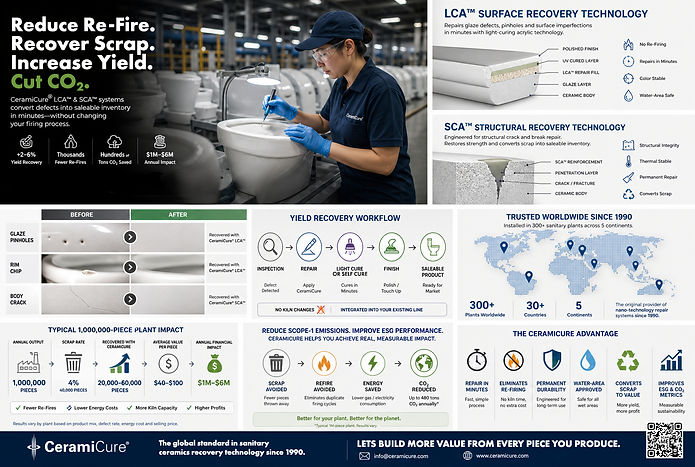
This case study profiles the environmental and financial performance optimization achieved by transitioning a baseline manufacturing line from a legacy “Refire/Scrap” workflow to an advanced inline “Repair/Recover” operational model when integrating CeramiCure® Light Cure Acrylic (LCA™) and Self Cure Acrylic (SCA™) into production finishing lines. High-volume facilities can achieve immediate cost compression, mitigate carbon taxation liabilities, and protect brand quality metrics before products leave the facility.
Executive performance indicators
516.2%
Net Annualized Return on Investment (ROI)
Sub-60 Days
Projected Investment Payback Horizon
991.3 Metric Tons
CO2 Footprint Abated
€677,848
Total Operational Value Recovered Annually
Case Study Parameters
Baseline Model Configuration
To evaluate the macro-impact of ambient-temperature recovery technology, this model assumes a theoretical baseline plant producing a standard volume of 500,000 units per year, utilizing average global ceramic industry benchmarks for energy consumption, material weight, and defect distribution:
-
Average Unit Parameters: Evaluated at a standard industry average of 25 kg per vitreous china unit.
-
Baseline Defect Distribution: Modeled at a standard 8% total quality defect rate (a 5% surface/glaze defect rate routed to secondary firing, and a 3% body defect rate routed to scrap destruction).
-
Recovery Efficiency: Assumes a conservative and realistic 85% successful yield recovery rate across both defect pipelines, accounting for 15% catastrophic defects that remain unrecoverable by any cold-cure protocol.
Modeled Environmental & Yield Outcomes
-
Secondary Firing Reduction: Diverting 85% of surface defects away from energy-intensive secondary kiln cycles eliminates a massive thermal utility burden, resulting in an atmospheric saving of 382.5 metric tons of CO2 based on standard natural gas utility coefficients.
-
Scrap Heap Diversion: Successfully recovering 85% of body defects eliminates the need for the plant to duplicate the energy and material inputs required to manufacture replacement inventory from scratch. This mitigates 608.8 metric tons of embodied CO2 liability.
-
Total Asset Recovery: The combined remediation of surface and structural body flaws restores a theoretical €677,848 in gross operational value back to the plant's baseline balance sheet through yield optimization, utility savings, and carbon penalty avoidance.
Transition from a "Refire & Scrap" Culture to
"Repair & Recover"
Transitioning to ambient-temperature inline recovery protects production margins through immediate yield optimization while de-risking the enterprise against tightening global carbon pricing and CBAM export penalties.
Submit an inquiry to our technical support group to request product samples and evaluate CeramiCure® integration parameters for your production line.
Methodology Disclaimers & Operational Assumptions:
-
Theoretical Performance Model: This case study is a theoretical simulation designed for educational and evaluation purposes only. It utilizes macro-level industry average benchmarks for weight, energy, and yield metrics. Actual operational yields, financial payback timelines, and localized carbon abatement metrics will vary based on facility-specific kiln configurations, regional utility rates, local labor burdens, and the geometric severity of individual ceramic defects.
-
Regulatory and Environmental Compliance: Carbon asset valuations are simulated using standard European Union ETS/CBAM baseline reference points (€75.00/t). CeramiCure® does not guarantee regulatory carbon credit monetization, automatic environmental compliance approvals, or specific monetary offsets; independent third-party auditing is required to validate site-specific carbon footprint reductions.
-
Technical Competency Targets: Modeled financial and environmental returns assume a factory-trained technician proficiency and an ongoing targeted product application success rate of 85%. This document represents a theoretical performance analysis and does not constitute a formal contract or a guaranteed warranty of merchantability.